When “Monitoring Liberty” Becomes a Fancy Word for Watching Free People
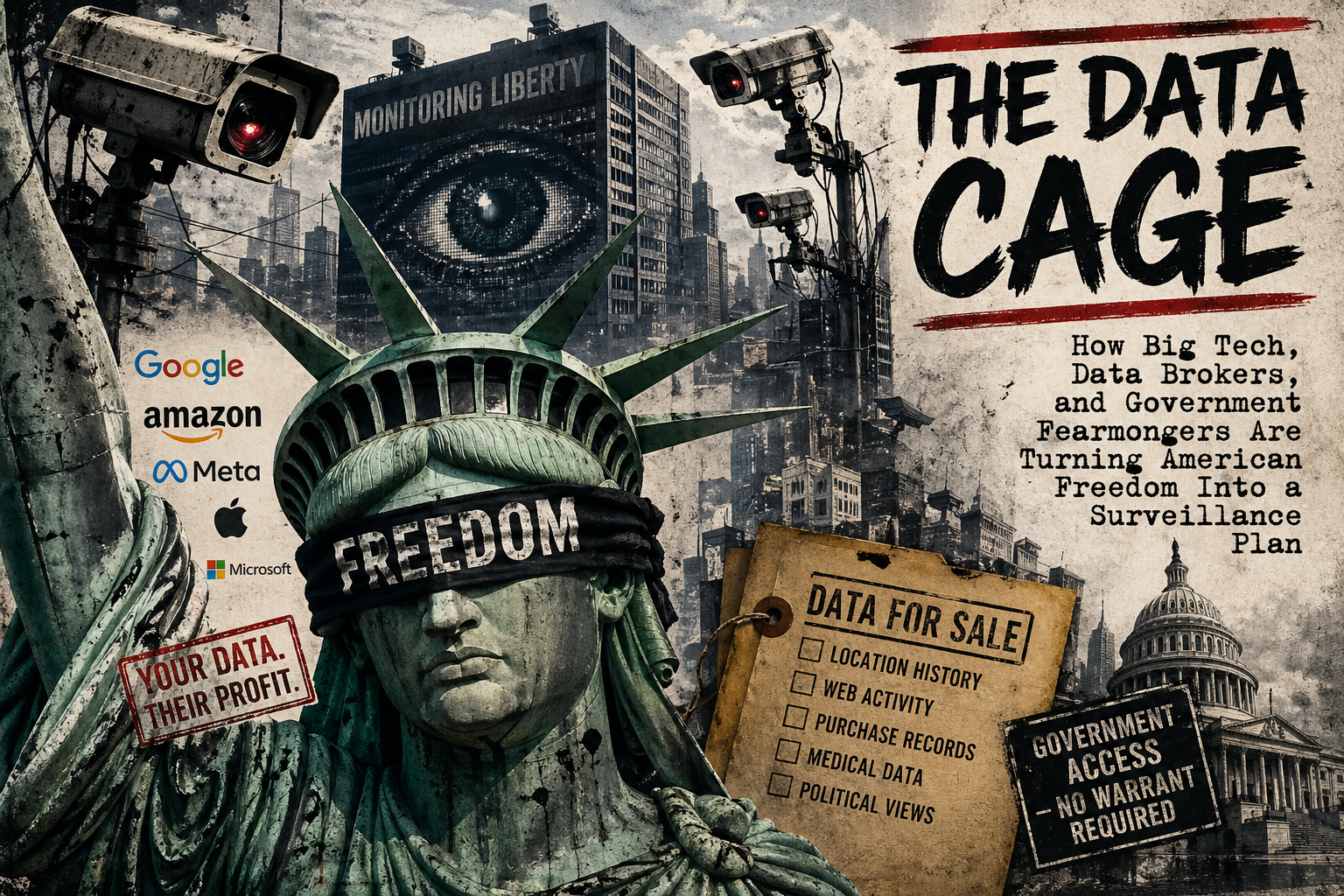
There are some phrases in American life that should make every decent citizen reach for his wallet, his lawyer, and possibly a shovel. “Monitoring liberty” is one of them.
It sounds harmless enough, doesn’t it? Clean. Corporate. Sanitized. Like something cooked up by a committee of nervous men in zip-up vests who drink oat milk and say things like “stakeholder alignment” while quietly designing a digital ankle bracelet for the entire country.
Monitoring liberty.
That is the kind of phrase a bureaucracy uses when it wants to put a camera in your kitchen and call it customer care. It is the kind of phrase a tech company uses when it wants you to believe surveillance is just freedom with better analytics. And it is the kind of phrase that should scare the hell out of any American who still has enough blood in his veins to remember that this country was not built to be managed like a prison yard.
America was not meant to be a policed state. It was not meant to be a place where every movement, purchase, search, click, prayer, protest, bad habit, late-night drive, medical visit, political donation, and half-drunk internet argument could be swept up, packaged, indexed, and sold like discount fertilizer to whoever has the cleanest invoice and the dirtiest imagination.
But here we are.
We are being sold fear by the pound. Unsafe. Unsecure. Vulnerable. Exposed. Threatened. Always threatened. The official message is simple: the world is dangerous, and because the world is dangerous, somebody must watch you. Somebody must gather the data. Somebody must build the database. Somebody must connect the dots. Somebody must know where you went, who you met, what you bought, what you read, and what kind of unpatriotic mood you were in when you did it.
And naturally, by sheer coincidence, that somebody always seems to be a government agency, a tech monopoly, a defense contractor, or some shadowy data broker with a name that sounds like an off-brand allergy medication.
This is not security. This is a business model with a badge.
The old argument was that the government needed powers to protect us. That was bad enough. But now the game has mutated into something slicker, uglier, and harder to pin down. The government does not always have to kick your door in anymore. It does not always have to get the warrant, stand before the judge, make the constitutional argument, and risk being told no. Why wrestle with the Fourth Amendment like a grown republic when you can just go shopping?
That is the rotten little trick at the center of this whole digital circus. If the government wants certain kinds of data on you, it may be able to buy it from companies that already collected it from your phone, your car, your apps, your browser, or your loyalty-card addiction to cheap coffee and bad decisions. Privacy advocates call this the “data broker loophole,” and the basic concern is brutally simple: information that would normally require legal process can be acquired through the marketplace instead. The Brennan Center has warned that agencies can purchase or otherwise acquire information from data brokers even when similar data held by traditional communications providers might require a warrant, court order, or subpoena.
That should make the paint peel off the walls.
The Fourth Amendment was not written as a customer-service suggestion. It was not a polite little Post-it note stuck on the door of the national security state. It exists because the Founders understood, in their bones, that power is a hungry animal. Give it a key and it will ask for the hallway. Give it the hallway and it will ask for the bedroom. Give it the bedroom and it will ask why you had the door closed in the first place.
The Supreme Court recognized in Carpenter v. United States that people have a serious privacy interest in the record of their physical movements captured by cell-site location data, and that law enforcement generally needs a warrant to obtain that kind of historical phone-location information. But the law has not caught up cleanly to the new bazaar of private surveillance, where companies collect data for “advertising,” “optimization,” “safety,” and all the other soft little lies that mean, in plain English, “we are watching because watching pays.”
And there is the difference between data “sharing” and data “selling,” which is mostly a difference in perfume. “Sharing” sounds like something children do with crayons. “Selling” sounds like what it is: a market. A transaction. A bagman in a nice suit. But both can end in the same dark alley. Your data leaves your hands, leaves your understanding, leaves your control, and winds up in a machine that can be used to profile you, price you, investigate you, manipulate you, or quietly mark you as a problem.
The Federal Trade Commission has been blunt about how big this machine has become. In 2024, the FTC said major social media and video-streaming companies engaged in “vast surveillance” of users, with lax privacy controls and inadequate safeguards for kids and teens. That is not some basement conspiracy theory scribbled in cigarette ash. That is the federal government itself saying the platforms are Hoovering up human life at industrial scale.
And the location-data racket is even nastier. In December 2024, the FTC accused Gravy Analytics and its subsidiary Venntel of unfairly selling sensitive consumer location data and collecting or using location data without verifiable user consent for commercial and government uses. The FTC also took action against Mobilewalla for collecting and selling sensitive location data tied to places like military installations, churches, healthcare facilities, and other sensitive locations.
Read that again slowly, preferably with a stiff drink and your phone in another room.
Military installations. Churches. Healthcare facilities.
That is not “improving the user experience.” That is building a map of the American soul and leaving it on the auction block.
This is where freedom starts to rot from the inside. Not all at once. Not with tanks in the street and some sweaty little dictator shouting from a balcony. It happens quietly, through convenience. Through apps. Through terms of service nobody reads because they were written by lawyers who appear to be paid by the syllable. Through bright blue buttons that say “I agree,” which is modern America’s version of signing a confession after the cops have already searched the house.
We have allowed ourselves to become hostages to tech companies because they made the cage comfortable. That is the genius of it. Nobody had to drag us into the cell. They gave us maps, music, delivery, streaming, dating, banking, news, jokes, porn, outrage, weather, and the ability to argue with strangers in seven time zones. Then they locked the door with our own thumbprint.
And now we are told this is normal.
Do you want safety? Give us the data.
Do you want convenience? Give us the data.
Do you want your child protected, your bank account secured, your city optimized, your borders controlled, your elections defended, your insurance priced, your feed personalized, your life made frictionless and shiny? Give us the data.
Always the data.
Security is the holy word now. Say “security” and Americans will tolerate things that would have made our grandfathers spit nails. Say “security” and people will accept surveillance they would never accept if it came wearing a brown shirt and carrying a clipboard. Say “security” and half the country forgets that liberty is not supposed to be efficient. Freedom is messy. It is noisy. It includes risk, stupidity, argument, privacy, bad choices, wrong opinions, and the sacred right to be left the hell alone.
That does not mean government has no duty to protect the country. Of course it does. I am not arguing for national suicide by naïveté. There are criminals. There are terrorists. There are foreign intelligence services. There are cartel networks, cyber gangs, predators, and all manner of digital vermin crawling through the wiring. Any serious person knows that.
But the line between security and freedom is not a decorative stripe on the floor. It is the whole damn battlefield.
When the state can know everything about you without properly asking, freedom becomes theoretical. When private companies can collect everything about you and sell access to it, consent becomes a joke. When government agencies can sidestep constitutional limits by buying data instead of compelling it, the Constitution becomes a speed bump for people too poor to hire better lawyers.
That is not liberty. That is managed citizenship.
And managed citizenship is a polite road to a policed state.
Congress has at least noticed the monster breathing in the closet. In April 2024, the House passed the bipartisan Fourth Amendment Is Not For Sale Act, a bill designed to stop law enforcement and intelligence agencies from buying Americans’ personal information without a warrant. But as usual in Washington, recognizing the fire and putting it out are two different sports. The machine is rich. The machine is useful. The machine has friends. And nothing in Washington dies harder than a power somebody already got used to using.
Meanwhile, the courts are still wrestling with how old constitutional protections apply to new digital tools. As of April 2026, the Supreme Court is reviewing geofence warrants, which can demand location data from devices near a particular place at a particular time, raising the question of whether proximity to a crime scene should be enough to drag innocent people into a digital police net. That case matters because it forces the country to answer a question we have been dodging for years: does carrying a phone mean carrying a government informant in your pocket?
That is the ugly heart of the matter.
We keep pretending this is about technology, but it is really about power. Who has it? Who watches? Who profits? Who gets searched? Who gets flagged? Who gets a knock at the door because an algorithm coughed up a pattern that looked suspicious to some contractor in a windowless office outside the Beltway?
The sales pitch says we are unsafe and need protection. Fine. Let us talk about protection. Protect us from criminals, yes. Protect us from foreign enemies, yes. Protect us from fraud, theft, terror, and chaos. But protect us also from the slow domestic creep of surveillance dressed up as innovation. Protect us from a government that gets around the Constitution by outsourcing its curiosity. Protect us from tech companies that collect our lives like vultures collect bones. Protect us from the smug little theory that free people must be monitored for their own good.
Because once liberty has to be monitored, it is no longer liberty in the American sense. It is parole.
And I do not remember anybody voting to turn the United States into a parole office with better branding.
The answer is not complicated, though the lobbyists will spend fortunes trying to make it sound that way. If the government wants sensitive personal data, it should get a warrant. If a company collects data, it should be forced to explain clearly what it collects, why it collects it, how long it keeps it, who gets it, and how much money changes hands. If data is sensitive enough to reveal where you worship, where you protest, where you seek medical care, where your children go, or where you sleep at night, then selling it should not be treated like selling lawn chairs.
And we, the citizens, have to stop acting like helpless cattle with unlimited screen time. Delete the apps you do not need. Turn off location tracking where you can. Stop giving every flashlight app the keys to your nervous system. Demand laws with teeth. Punish politicians who talk about freedom on July Fourth and then let agencies buy your private life in bulk on July fifth.
The old republic was built on a dangerous idea: that free people could govern themselves without being watched like inmates. That idea is still worth defending. It may be battered, half-drunk, underfunded, and sitting in the back of the bar muttering about better days, but it is not dead yet.
Not unless we let the bastards sell it back to us as a subscription service.